


“Macedonia 🇲🇰 ~Samuel’s Fortress in Ohrid”
We spent most of our day on the road, driving from Strumica to Ohrid; East to West. It was a beautiful drive. We had hopes of spending the night next to the Fort we visited, but given that this was Friday, and Ohrid is the most popular place to visit in all of Macedonia, our hopes were dashed. No vacancies. We stopped at four or more stays and inquired. No worries, because we did not care for the prices of this popular lakeside city, anyway.


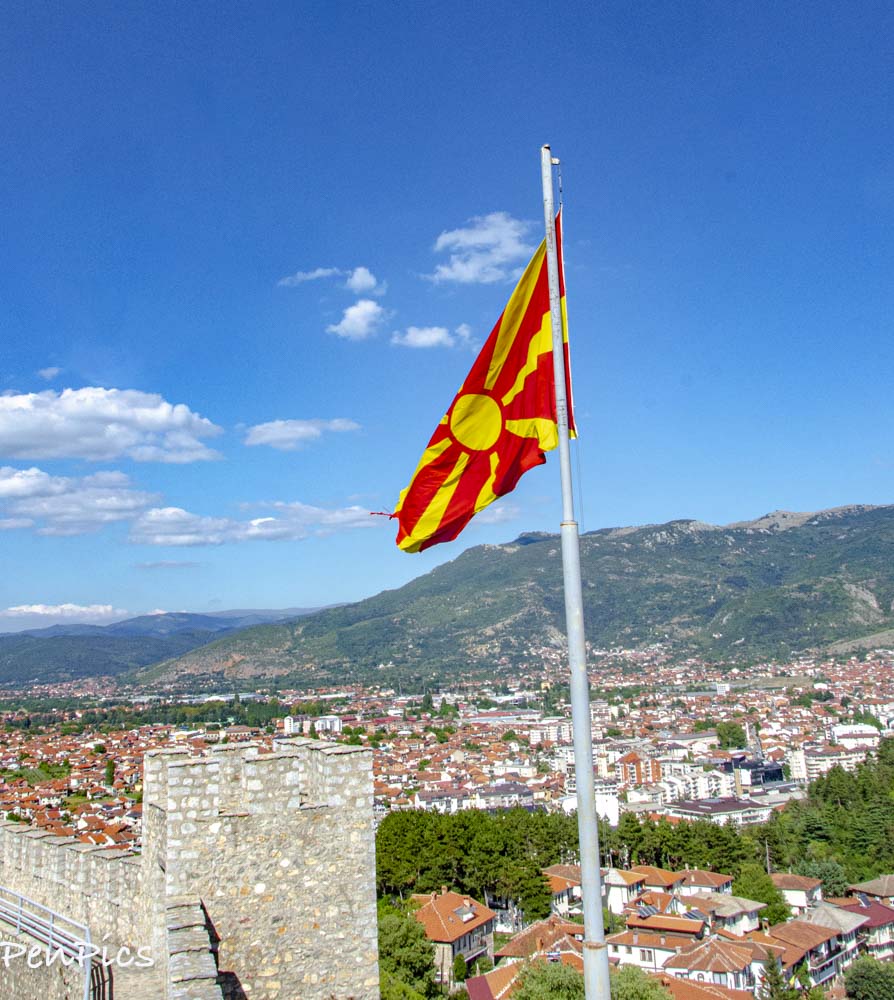
The main part of the Fort is well preserved, with a few watch towers and four original gates. We are really into to old Fortresses, so the hike up the hill was worth it to us, for both gaining a better understanding of the former strategic importance of Ohrid and for the related and spectacular views of the lake and surrounding mountains.


With its ramparts and fortified towers, the Fortress occupies the entire Ohrid hill which rises to above; over 328 feet above sea level from the lake.
From all sides, with the exception of the southern side; which is facing the lake, the city was being protected by high walls and defensive towers, which spread to the Ohrid port. The heights of the ramparts vary, depending on the configuration and accessibility of the terrain.
In the oldest sources, under the name of Polybius; using the ancient name of Ohrid Lake, it is pointed out Macedonian king Philip II, made a decision to build a Fortification on the hill above the lake.
The oldest historical data on the city Lychnidos, which is also the ancient name of Ohrid city, along with the Fortress itself, date back from 209 BC, where it is said the Fortress was built and functioned in all the crucial moments in the history of the city. The chronicler; Malchus (Malala), noted in 478 that the Fortified City had strong defensive power, because Ostrogoth king Theodoric the Amalian, with his military march toward the New Epirus, did not succeeded in conquering Lychnidos. This was because the city and its Fortified stronghold were strong with its sustaining springs within its walls.
Throughout history the Fortress has been destroyed many times, rebuilt and upgraded, so it bears marks from almost all the historical epochs when Ohrid was ruled by the Romans, Byzantines, Slavs and Ottoman Turks. However, it is believed that most of the walls of the Citadel and suburban area, along with the preserved towers, date from the time of the emperor Samuel, from 976 to 1014, and then, from the time of his successors until 1018, when Ohrid was the capitals of the first state of the Macedonian Slavs. From that time, until today, the Fortress is known as Samuel’s Fortress.
After the full collapse of the empire and falling again under Byzantine rule, emperor Basil II fully destroyed the Fortress. Later, probably Byzantine emperor Alexios I Komnenos restored it again. Also, in the second half of the 14th century, at the time of the reign of the Great Prefect Andrea Gropa in Ohrid County; between 1371 and 1385, the Citadel was restored again.




We enjoyed touring around Ohrid, because it is quite spectacular, and well worth the time to visit. Its a beautiful area. After we were filled up with touring, we stopped to rest with an iced coffee, then we we got back in the car and drove on. I drove about seven hours, total, yesterday, so when we found a roadside hotel we stopped. Hotel Panorama near Merdita is nice; good price, under budget, because no A/C, and a good chicken fried steak dinner. We were both looking forward to sleep, after our big day. Though this hotel is remote, in the mountain pass area, the road noise was pretty bad. Currently, I am still looking forward to sleep, tonight and it’s only 9:40AM! 🤣
We loved the Fortress visit as well as and the Church visit (photos coming of the church) before leaving Ohrid. Incidentally, when we crossed the border to Macedonia the first time; from Albania, from the west side, we stayed our first night in Struga; next to Ohrid Lake (other side of this huge lake) which is only a few miles from this part of Ohrid. We did not have a car, as yet, so we figured we would be back, when we rented one– and we did!
Today, we have a couple of hours to drive, still; this time from West up to North, to reach our next destination. Daryls turn to drive 😉


About Us

About Us
Hello and Welcome to our Travel Blog Website, We enjoy writing about our experiences and taking photos of our adventuring along the way. Our names are: Daryl and Pen, but Daryl calls me “Bunny.” We met, quite randomly, whilst both traveling in Thailand with friends. We happened to be in the same travel group, and […]
Tsar Samuel is a “controversial figure” in “Macedonian” history for a very good reason – he was the tsar of the First Bulgarian Empire. Oh yeah, also his name is not Tsar Samuel. His full title is Tsar Samuel of Bulgaria. North Macedonians conveniently forget the second half of the name of the Bulgarian medieval tsar. North Macedonia is systematically appropriating Bulgaria’s medieval history in the Western Balkans. That is a state-building ideology. By the way, every empire has a name. And so-called “Samuel’s empire” was one of the largest states in medieval Europe, so there are many contemporary sources – French, Byzantine and Arabic to name a few – which clearly give the name of “Samuel’s s-called empire”. Meaning, it is not a secret and there is no reason to use enigmatic euphemisms like “Samuel’s empire” or “Slavic empire”, etc. The name of “Samuel’s empire” was simply Bulgaria. But do not tell that to a “Macedonian”-This is an embarrassing taboo in North Macedonia.
Okay