


“Ethiopia 🇪🇹 ~Legendary Bath and Palace Ruins of The Queen of Sheba in Axum”
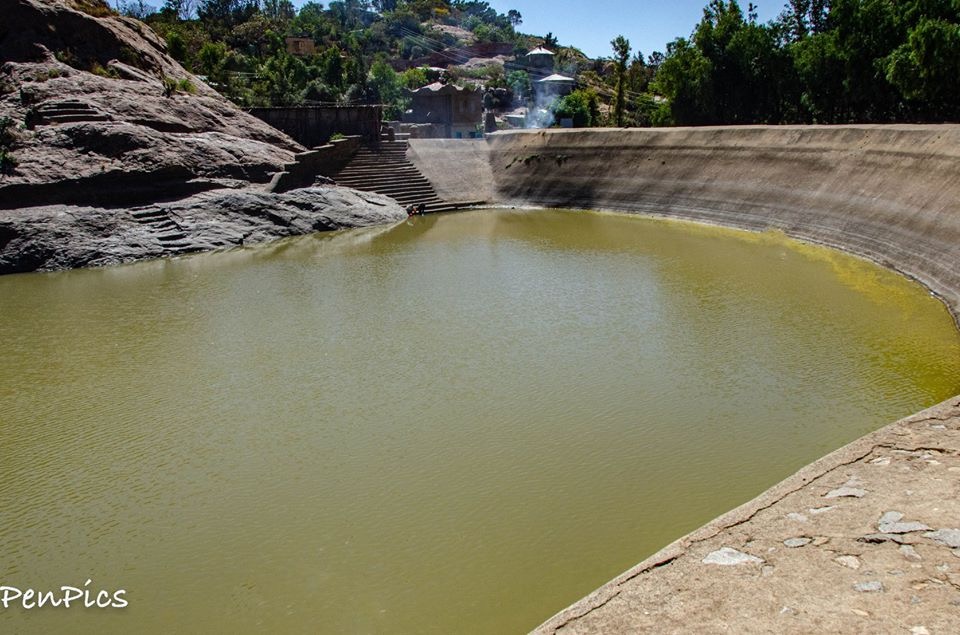
Despite the colourful legends, this large reservoir probably wasn’t where Sheba came to bathe. It was an important reservoir rather than a swimming pool or gargantuan bath. Nobody is totally sure of its age, but it’s certainly been used as a water source for millennia
Its large size is even more impressive considering it’s hewn from solid rock. It’s also known as Mai Shum, which translates to “Chief’s Water.” It’s used for the Timkat celebrations, just like Fasiladas’ Bath in Gonder
Sadly, the outer portion of the bowl was coated with concrete in the 1960s, making it look more like a modern trough than an ancient relic


The structure at Dungur is popularly known as Queen of Sheba’s Palace, though archaeologists are divided over whether it was the great woman’s palace or the 6th-century-AD mansion of a nobleman. Most leaned towards the latter, but the find during recent excavations of a relief carving depicting a beautiful woman (in the museum at Saint Mary of Zion Church) has caused some to wonder whether her palace may lie beneath the current ruins…. regardless, Climb the observation tower at the back of the site for a view out over the 50-room layout. It has small undressed stones and walls recessed at intervals and unusually tapering with height. The well-preserved flagstone floor is thought to have belonged to a throne room. The palace also contains hidden treasure rooms, a private bathing area and a kitchen, where a large brick oven can still be seen. The stairwells suggest the existence of at least one upper story

There are countless regional folk stories that describe the Queen of Sheba, but when we boil it down there is a common narrative that winds through these accounts, as well as the three religions of Judaism, Christianity, and Islam
The basic story is that the Queen of Sheba was a woman of immense wealth and power. Her kingdom seems to have been somewhere in northwest Africa, and considering her wealth it’s assumed that she controlled major trade routes, as well as some impressive gold mines. In all accounts, she is described as offering lavish and incredible gifts of gold, spices and other valuable items as part of her diplomatic interactions.
The Queen of Sheba was also renowned for her wisdom. In fact, she is so intelligent and clever that she appears in these religious texts as a potential equal to Solomon, the 10th century BC king of Israel who is generally upheld as the wisest figure in Jewish history. It’s important to remember that Solomon lived long before any split between Judaism, Christianity and Islam (all of which have a shared history)


Archive Blog Posts of Our Country Visits
About Us

About Us
Hello and Welcome to our Travel Blog Website, We enjoy writing about our experiences and taking photos of our adventuring along the way. Our names are: Daryl and Pen, but Daryl calls me “Bunny.” We met, quite randomly, whilst both… Read More