


“Ethiopia 🇪🇹 ~Saint Mary of Zion; Home to the Original Holy Ark of the Covenant in Axum”
The introduction of Christianity in the 4th century AD resulted in the building of churches, such as Saint Mary of Zion, rebuilt in the Gondarian period, in the 17th century AD, which is believed to hold the Ark of the Covenant.


Although the present building is relatively new, the Church of Saint Mary of Zion has impressively ancient roots
In the 4th century, the Axumite prince Ezana was instructed in Christianity by two Syrian monks, shipwrecked on the Red Sea coast. The prince promoted Christianity when he became King Ezana, and he is regarded as a saint in both the Ethiopian Orthodox and Catholic Churches
It was around this time, in the 300s AD, that a Church of Saint Mary was first built in Axum. This church stood for hundreds of years and was seen by a Portugese friar shortly before its destruction in the 16th century….a Francisco Alvarez wrote this in his journal:
Some experts believe this great church in Axum served as the model for Bet Medhane Alem, one of the most impressive of the rock-carved churches in Lalibela
Axum was the first Christian kingdom in the world and the largest outside the Roman Empire. Situated on the caravan trade routes to Arabia, Nubia and Egypt, Axum traded as far away as Greece, Rome and Constantinople
In the later 5th century, Christianity was spread beyond the royal family to the general populace through missionaries fleeing from the Eastern Roman Empire. The missionaries adhered to the Monophysite doctrine of Christ’s nature after it was branded heretical in 451 by the Council of Chalcedon, a doctrine that remains part of Ethiopian Orthodox and Coptic Orthodox Christianity today
In the 6th century King Kaleb (also called St. Kaleb made Axum a great military power and took on the role of protector of Christians in the region, including Arabia. Kaleb conquered several small Jewish kingdoms in Arabia, which led to the incorporation of Jewish customs into Ethiopian Christianity that can still be seen today
In 1635, Saint Mary of Zion was reconstructed by Emperor Fasilidas on the ruins of the church that had been destroyed by the Muslims, and this is the church that stands today. In the mid-1500s, the forces of Ahmed Gragn “the Left Handed” had swept across the Horn of Africa from Harar in the east, for a time threatening the extinction of Ethiopian Christendom
The destruction and rebuilding of the church has become an important part of its meaning for Ethiopians. Surrounded by Islamic countries, overrun several times, and brought to the brink of extinction, Ethiopian Orthodox Christianity regards itself as a bastion against Islam
Saint Mary of Zion’s rise from the ashes symbolizes the struggles and triumphs of not only the church, but the nation of Ethiopia. The emperors of Ethiopia were all crowned here. Until the 1930s, criminals could receive sanctuary in the church precincts by ringing the bell on the porch
In 1955, to mark his Silver Jubilee, Emperor Haile Selassie founded a new Church of Saint Mary of Zion next to the old one. It was completed in 1964. Emperor Selassie interrupted the state visit to Ethiopia of Queen Elizabeth II to attend the dedication of the Cathedral. The British monarch visited Saint Mary of Zion herself a few days later. Unlike the original Saint Mary of Zion, the new Saint Mary of Zion allows entrance to women.
In 1965, Selassie built a relic chapel next to Old Saint Mary’s to hold the church treasures and the revered Ark of the Covenant
Axum was in the battle zone during the liberation war against the central government in the 1980s. Marxist forces were accused of plundering 83 churches in the area and killing a number of priests, but thankfully the ancient shrines of Axum were not seriously damaged


Ethiopian tradition claims the Ark, which allegedly contained Moses’ stone tablets on which the Ten Commandments were written, was smuggled to Ethiopia by their son Menelek and is still in this country
The Ark of the Covenant is the most reserved holy relic of God’s incarnate and became part of the Ethiopian Orthodox Tewahedo Christian belief. The presence of the Ark of the Covenant in every Ethiopian Orthodox Tewahedo Church and the belief in it, exert a profound influence on the imaginations and spiritual lives of many Ethiopians. According to the Ethiopian Orthodox Tewahedo Church, this priceless treasure (the Ark of the Covenant) still exists and rests in a small chapel in the monastic complex of Saint Mary of Zion church in Aksum. This makes Saint Mary of Zion the holiest sanctuary in Ethiopia. It does seems likely that the Ark was brought to Ethiopia when Menelik returned to Aksum from his visit to his father, King Solomon. Ever since the Ethiopian monarch claimed to be a direct descendant from the biblical King Solomon and the Queen of Sheba, and ruled Ethiopia in an unbroken line until the revolution broke out in 1974 which ended the Ethiopian monarchy

various worshippers around the Church


Male pilgrims cannot go beyond the vestibule and women are confined to the courtyard.
During services, the small church is quickly overwelmed by the crowds of worshippers, whose sonorous chanting rises and falls in a wave of sound. When the priests emerge from the Holy of Holies to carry the Gospel book in procession or bring the Eucharist to the people, they wear bright robes and are shielded by splendid ceremonial umbrellas.
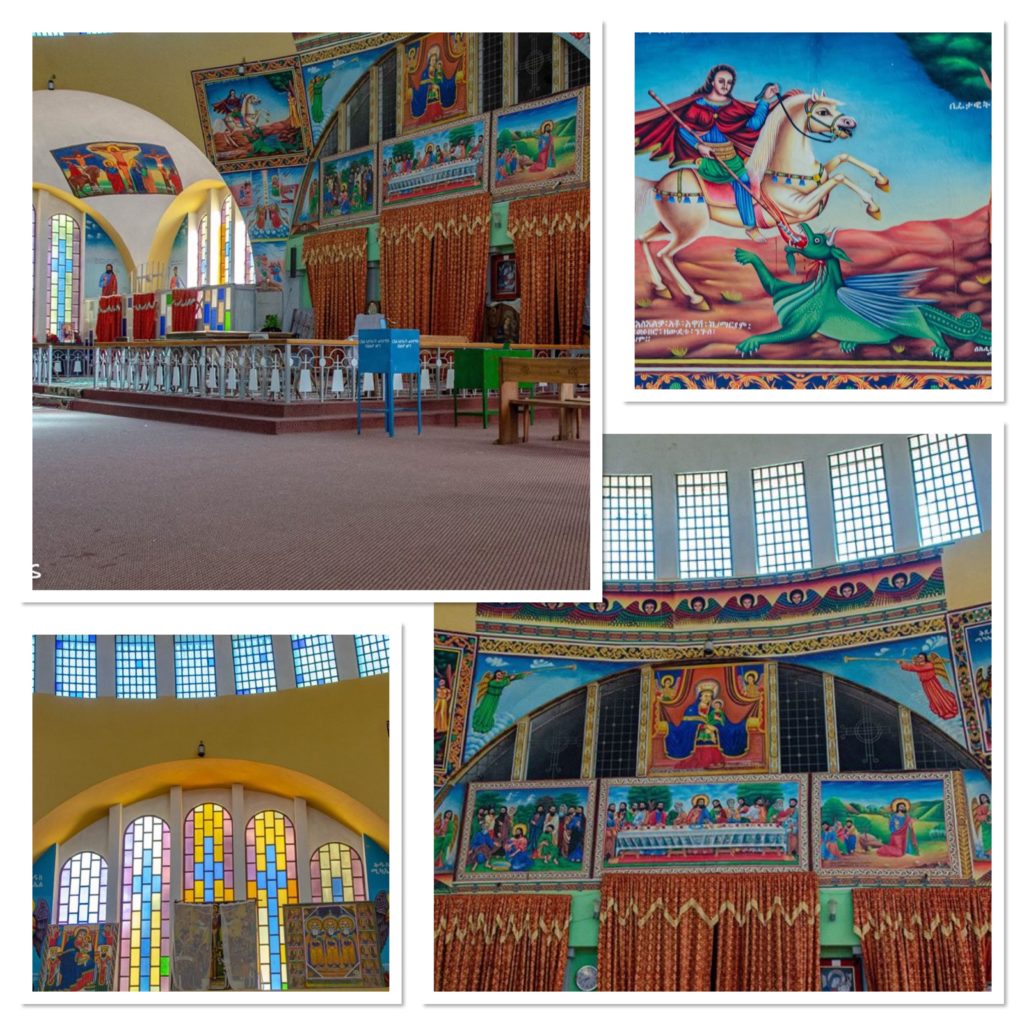
The new St. Mary of Zion is modern in its architecture, more spacious than the old one, and decorated with colorful art. It was built in a modern interpretation of the Greek Byzantine style with Ethiopian influences. At the front of the church is a large painting depicting the Holy Trinity, the Twelve Apostles, and the Twelve Tribes of Israel

About Us

About Us
Hello and Welcome to our Travel Blog Website, We enjoy writing about our experiences and taking photos of our adventuring along the way. Our names are: Daryl and Pen, but Daryl calls me “Bunny.” We met, quite randomly, whilst both traveling in Thailand with friends. We happened to be in the same travel group, and […]