


“Armenia 🇦🇲 ~Geghard Monastery in the Upper Azat Valley”
This afternoon, as we drove around a bend in the road, this scene which unfolded will be forever burned into my brain. From up high, we could look down, over the valley and see many beautiful sites! Firstly, the Monastery on the left, built into the cliffs of the mountainside. The cliffs all around were spectacular, and on those high reaches of the craggy area were a white painted cross stood out, magically!


Translated from Armenian, Geghard means “spearhead,” and Gegardavank means “monastery of spear” respectively. After the crucifixion, the “Longine’s Spear” was taken to the Monastery. At present, the main relic of Geghard; the spear, is stored in the treasury of Echmiadzin, which is the spiritual center of the Armenian Apostolic Church.
(we visited this place, but it was closed to visitors while under construction)
Geghard is an architectural wonder. It is a complex of churches hewn from within a mountain of solid rock.
On the way to Geghard, passing through the towering cliffs along the gorge of the Azat River, there are numerous caves which were once carved into the rocks. In these caves, archaeologists have found numerous cave paintings. This proves that at one time, the are was inhabited by Prehistoric men.

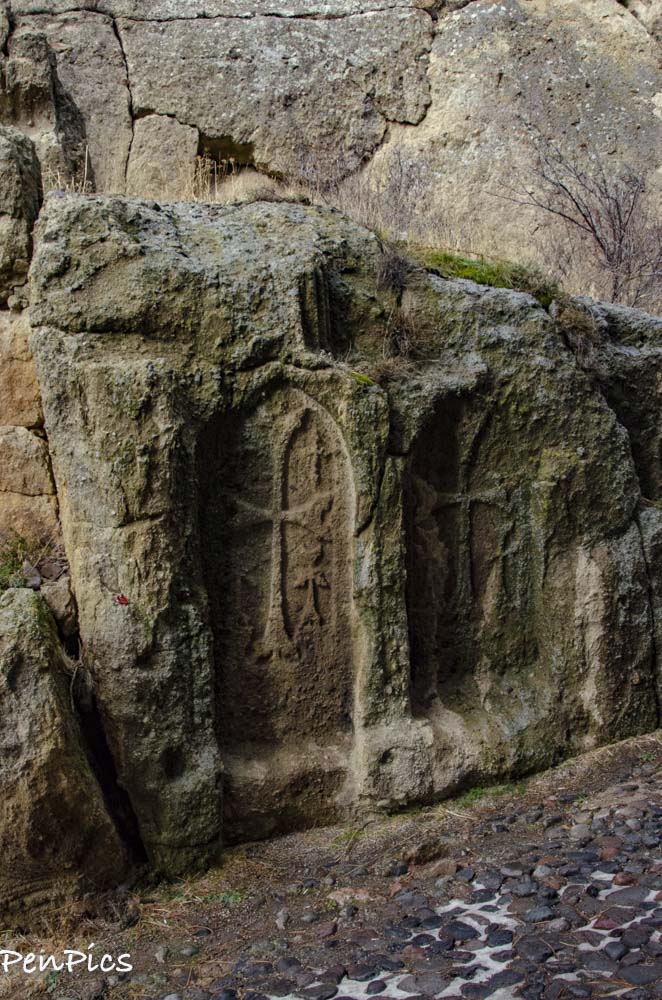
I couldn’t wait to get into the Monastery. I have loved all our sightseeing visits so far, but this Medieval Monastery had so many special features; including a spring running through the church. Also, there were so many Khachkars or Armenian Cross Stones, still original, in perfect condition, carved right into the mountain. In the back of the church, there is an old bridge (reinforced with a railing). The backdrop to the old bridge of more mountain scenery was breathtaking. The bridge was slick with ice, and so was the trail that looked like it went into a cave, beyond the bridge. I did not venture.


The Kathoghikè (main church)
High cliffs from the northern side surround the complex while the defensive wall encircles the rest. The monuments included in the property are dated from the 4th to the 13th century. At an early period, the Monastery was called Ayrivank (Monastery in the Cave) because of its rock-cut construction.
The monastery was founded, according to tradition by St. Gregory the Illuminator, and was built following the adoption of Christianity as a state religion in Armenia (in the beginning of the 4th century AD). The main architectural complex was completed in the 13th century AD and consists of the cathedral, the adjacent narthex, eastern and western rock-cut churches, the family tomb of Proshyan princes, Papak’s and Ruzukan’s tomb-chapel, as well as various cells and numerous rock-cut cross-stones (khachkars).


I heard the water, before I saw it. There is this cave-room off to the left, as we entered the main door into the church. I followed the sound. There is very low light inside these structures, so with the aid of my camera and flash, I could see what was inside the cave-room with the natural spring, I felt a very strong spiritual vibe inside this cave. Perhaps the locals and believers look at this water as holy water. It certainly is sacred to them. I saw a few men drinking the water, too.
The exact date for the founding of this Monastery is unknown, but pre-Christians worshiped at springs at the site, particularly one inside this cave that is now enclosed by the main gavit.
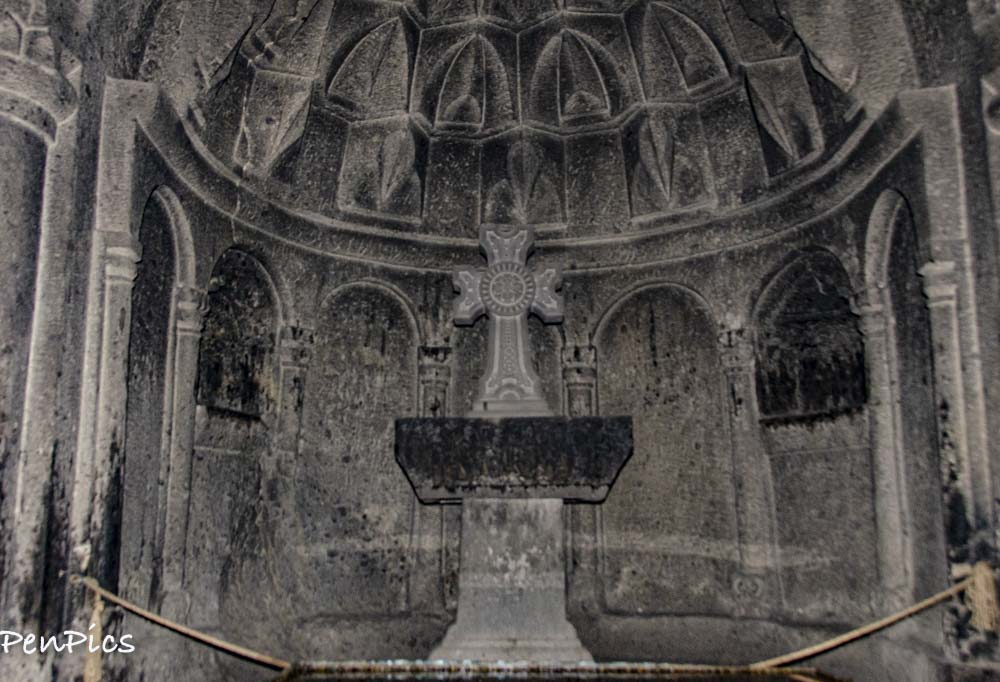
I pointed my camera at this wall. I had no idea it had so much detail. I could not see much in the dark.
The principal structure, the church of the Virgin, is a cruciform building from the second quarter of the 13th century. It has a four-column gavit (1225) to the west of the church.


It is believed the Monastery was established at the site in the beginning of the 4th century by the first Catholicos; St. Gregory the Illuminator (S. Grigor Lusavorich) and became known as “Aiyrivank” or “Monastery of Caves.” It was developed by Gregory and a later Catholicos, St. Sahak Partev, who was head of the Church at the time the Armenian Alphabet was invented. The ascetic lifestyle of monks is illustrated by the numerous small caves on the cliffs inside and surrounding the site, exposed to the elements and many reached only by ladder or rope. Gregory is believed to have lived in one of these cells.


The Azat River flows through the grounds of this Monastery complex


This is the most ancient preserved monument outside the ramparts and is located on the western side. It is partially hewed in the rock. There are engraved inscriptions on the walls, the earliest of which date back to 1177 and 1181 AD. Residential and economic constructions were built later, in the 17th century.

Rock cairns are human-made stacks, mounds or piles of rocks. They take different forms, and have been built by cultures around the world for many different purposes. Cairns may serve as monuments, burial sites, navigational aids (by land or sea), or ceremonial grounds, to mention a few of their purposes.
We have been fortunate to see many Cairns, placed all over the world.

We timed our visit, perfectly, because as we arrived, the fog started to roll in. At first, it was just enough to make the scene even more enchanting, but after we toured around the grounds, the fog was as thick as pea soup; so much so, we were lucky to find a remote hotel, so the big guy did not have to drive any further. The road to go to our next stop doesn’t seem to be too good. It’s pretty clear from snow and ice, but bad in every other way. We will see if it’s easier to drive without the fog, and try again, tomorrow.

In addition, since we had to go back towards the city to find lodging last night, and repeat our drive to get to todays sites, we drove right by Garni Temple. We decided to stop in and see if the gate was open. AND, it was. We paid our $6, proper, plus some change for parking, and entered the grounds and walked to the back, where we could see the Garni Temple up close and inside. It would have been quite an undertaking to put that Temple back together, but it looked pretty good, and the fact it is the only Greco-Roman colonnade building in Armenia makes it a must to see. I added the Garni Temple photos from today, to my blog from yesterday; too keep all the photos together. If you want to see the additional photos of Garni Temple, here is the link to take you back to yesterdays blog: https://2gypsiesinthewind.com/asia/armenia/armenia-tsaghkadzor-kecharis-monastary-and-garni-temple/


About Us

About Us
Hello and Welcome to our Travel Blog Website, We enjoy writing about our experiences and taking photos of our adventuring along the way. Our names are: Daryl and Pen, but Daryl calls me “Bunny.” We met, quite randomly, whilst both traveling in Thailand with friends. We happened to be in the same travel group, and […]
amazing picture and beautiful place thank you for creating this article
Thank you
That is a very cool place! I was thinking Armenia, whats there to see. Well…. alot. Thanks for sharing your adventures.
Yes, there are many sites to see…the lowland city and towns are not so pretty (very poor and former soviet era Communism never is great). But, if one has time, it is worth a visit. A long time ago we considered doing a tour of Georgia, Azerbaijan and Armenia. Could not believe the price for such. Glad we are doing it this way. We are seeing all the same things, at a fraction of the cost.