


“Ethiopia 🇪🇹 ~The Birthplace of Ethiopian Civilization… Main Stelae Field in Axum”
We toured around Axum, and made many stops…Such ancient histories, here!

The ruins of the ancient city of Axum are found close to Ethiopia’s northern border. They mark the location of the heart of ancient Ethiopia, when the Kingdom of Axum was the most powerful state between the Eastern Roman Empire and Persia.
The massive ruins, dating from between the 1st and the 13th century A.D., include monolithic obelisks, giant stelae, royal tombs and the ruins of ancient castles.
Long after its political decline in the 10th century, Ethiopian emperors continued to be crowned in Axum


The megalithic Tomb of Nefas Mawcha consists of a large rectangular central chamber surrounded on three sides by a passage. The tomb is unusual for its large size, the sophistication of the structure and the size of the stones used for its construction The force of the Great Stelae crashing into its roof caused the tomb’s spectacular collapse.
Locals believe that under this tomb is a “magic machine,” ….the original implement the Aksumites used to melt stone in order to shape the stelae and tombs. The same type of machine was apparently also used to create some of the rock-hewn churches of Tigray.
Amazingly, about 90% of the field hasn’t yet been dug, so no matter where you walk, there’s a good chance there’s an undiscovered tomb with untold treasures beneath. This is part of Aksum’s appeal: the thought that fascinating finds and secrets lurk in the depths. That said, these are some of the ancient world’s most striking monuments.


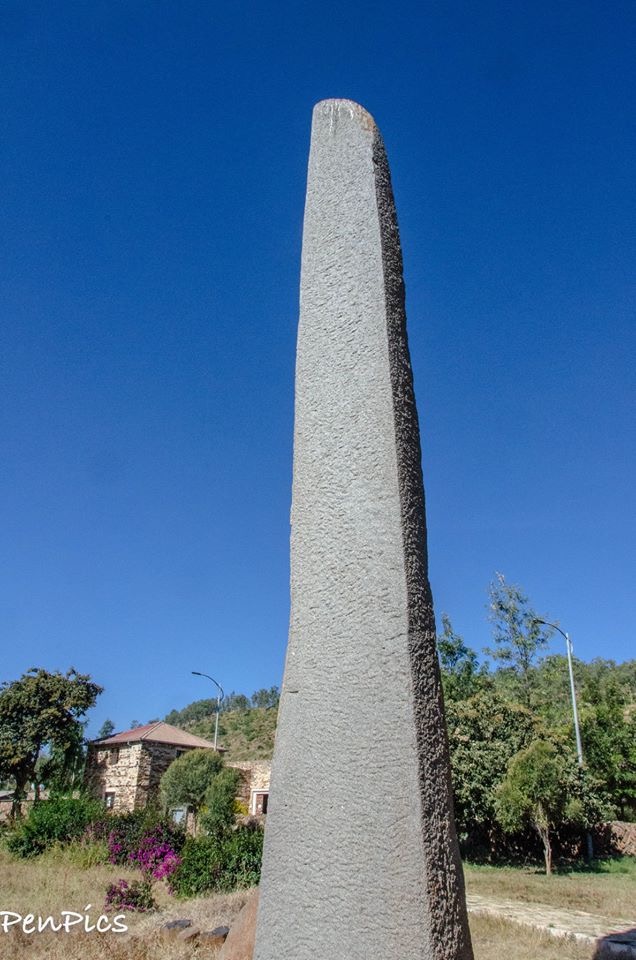
The largest obelisk of some 108 feet long lies where it fell, perhaps during the process of erection. It is possibly the largest monolithic stele that ancient human beings ever attempted to erect.

All of the tombs excavated to date had been pillaged by robbers, so very little is known about Aksumite burial customs or the identities of those buried.
Tomb of the False Door
In 1972 the unique Tomb of the False Door was discovered. It lies in the western extremity of the Northern Stelae Field and is thought to date around the 4th century AD.
Complex in structure, its stone blocks are also larger and more finely dressed than those found in some other tombs. Comprising an antechamber and inner chamber, it’s surrounded on three sides by a passage.
Above the tomb, at ground level, a rectangular, probably flat-roofed building would once have stood. Above the stairs descending into the tomb’s chamber, was a stone slab carved with a false door; almost identical to those found on the stelae. Look for the iron clamps fixing blocks of stone together like giant staples.
Judging from the lengths to which the grave robbers went to gain access, it’s thought to have contained objects of great value. A single stone base that held the sarcophagus can still be seen.
Mausoleum
The so-called mausoleum has a monumental portal (hewn from a single slab of granite) marking the tomb’s entrance and is carved with the stelae’s curious false-door motifs. The portal leads into a passageway with 10 chambers.
Part of the tomb was disfigured at some unknown date by robbers, who succeeded in digging through solid masonry.


Archive Blog Posts of Our Country Visits
About Us

About Us
Hello and Welcome to our Travel Blog Website, We enjoy writing about our experiences and taking photos of our adventuring along the way. Our names are: Daryl and Pen, but Daryl calls me “Bunny.” We met, quite randomly, whilst both… Read More