


“Ethiopia 🇪🇹 ~The Ura Kidanemehret Monastery on Lake Tana”
Day 1: After our full day of traveling the local areas and sites of Bahir Dar and Tis Abay, we ended our time, back at Lake Tana, where we had breakfast; way earlier, but this time, we would ride a boat across the big lake to hike to one of the three ancient Monasteries on the islands



Pelican 
Schools of Hippos can be seen on Lake Tana


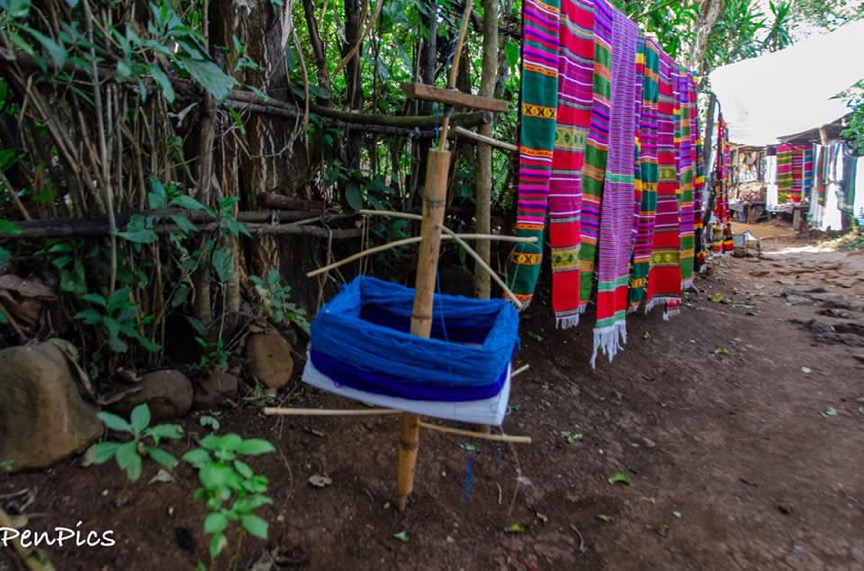
Lots of huts with shops 


The Lake is known as the home of the Monasteries. One such is named Ura Kidanemehret; a church of the Ethiopian Orthodox Church, located on the Zege peninsula in Lake Tana of Ethiopia.
It is part of the complex of the Convent of Mercy. At least one author considers it the most attractive church in the Lake Tana region. The convent was founded in the 14th century by the saint Betre Mariyam (Amharic “Rod of Mary”), although the present circular church dates from the 16th century.
The seven ostrich eggs on the cross mean that you’re supposed to be in church seven days a week. Why ostrich eggs? Because ostriches never leave their eggs and you should never leave the church!
The outer corridor, the “qene mehlet,” is accessible to anyone. The church itself is deceptively simple on the outside; a large, round building topped by an elaborate cross– but when we pass through the tall wooden doors right away one stops short, to take in the brilliantly, colorful fresco paintings that reach from floor to ceiling, reaching from floor to ceiling. Its walls are decorated with numerous frescos, painted between 100 and 250 years ago; subjects include Negus Tekle Haymanot of Gojjam and his followers. The most significant were painted by Alaqa Engida during the reign of Emperor Menelik II.
Every inch of the walls are covered in paintings. Some scenes are familiar, like the Crucifixion and St. George defeating the dragon.
Many of the churches and monasteries of Lake Tana are very famous cultural museums because of their beautiful mural paintings and many other valuable treasures such as varieties of crosses, crowns, costumes of Kings, illuminated manuscripts, mummified bodies and remains of several Ethiopia Emperors in wooden coffins and glass boxes.
The Ethiopian Orthodox Church includes many such books in their canon. The books of Enoch and Jubilees were translated into Ge’ez, the ancient Ethiopian language still used in church services, but were lost to the West and survive in the New Testament only in a few quotations. If it wasn’t for ancient Ethiopian translators, these books would be almost entirely unknown
The paintings are vivid, showing scenes of miracles and worship. Mary is a popular figure and every phase of her flight to Egypt is shown in detail. There’s also a brilliant painting of all the souls in Hell being freed after the Crucifixion


About Us

About Us
Hello and Welcome to our Travel Blog Website, We enjoy writing about our experiences and taking photos of our adventuring along the way. Our names are: Daryl and Pen, but Daryl calls me “Bunny.” We met, quite randomly, whilst both traveling in Thailand with friends. We happened to be in the same travel group, and […]